Solutions > Bluetooth® Periodic Advertising with Responses

Principle
Roles
Two roles are defined for PAwR: the PAwR Advertiser and the PAwR Scanner.
- PAwR Advertiser: As the initiator of communication, the PAwR Advertiser transmits periodic advertising packets within each communication window. Following its transmission, the device switches to receive mode at a designated time within the same window to listen for responses from PAwR Scanners.
- PAwR Scanner: As the responder in communication, a PAwR Scanner listens for advertising packets from the PAwR Advertiser during the designated communication window. It may then send a message to the PAwR Advertiser at a specific, application-determined time within that window.
Timing
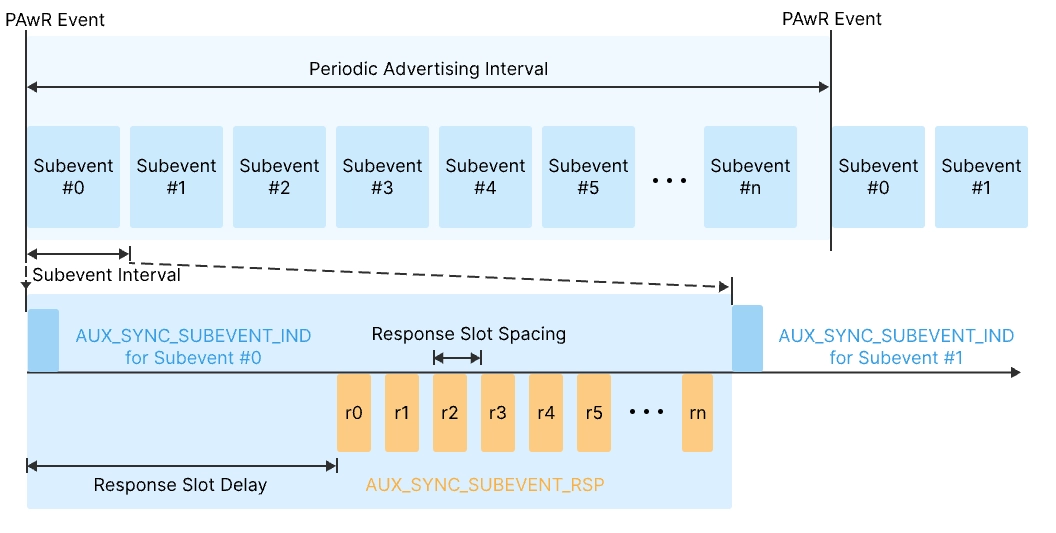
The following diagram illustrates the PAwR timing structure. A periodic advertising with responses event is divided into multiple subevents. Each subevent contains a response slot delay interval followed by one or more response slots. The PAwR Advertiser transmits advertising packets in every subevent. A PAwR Scanner may synchronize to all or a specific subset of these subevents and will only listen for packets in its synchronized subevents. Upon receiving a packet, a PAwR Scanner may send a response to the PAwR Advertiser within a designated response slot of any subevent.
Communication Topology
The following diagram illustrates the communication topology established by PAwR, which is a centralized, one-to-many star topology. The Subevent mechanism can be used to logically group PAwR Scanners. For example, PAwR Scanners with different functions or located in distinct areas can be assigned to the same subevent for management. Furthermore, a PAwR Scanner may synchronize to multiple subevents to receive the corresponding advertisements. This allows PAwR Scanners with overlapping functionalities to receive information from multiple groups. PAwR Scanners transmit messages to the PAwR Advertiser in the response slots. PAwR Scanners do not receive messages from other PAwR Scanners. Within this topology, all timing parameters for communication are defined and configured by the PAwR Advertiser. The entire topology's communication relies on the PAwR Advertiser; therefore, a failure of a single PAwR Scanner has limited impact on the overall communication, whereas a failure of the PAwR Advertiser will halt all communication.
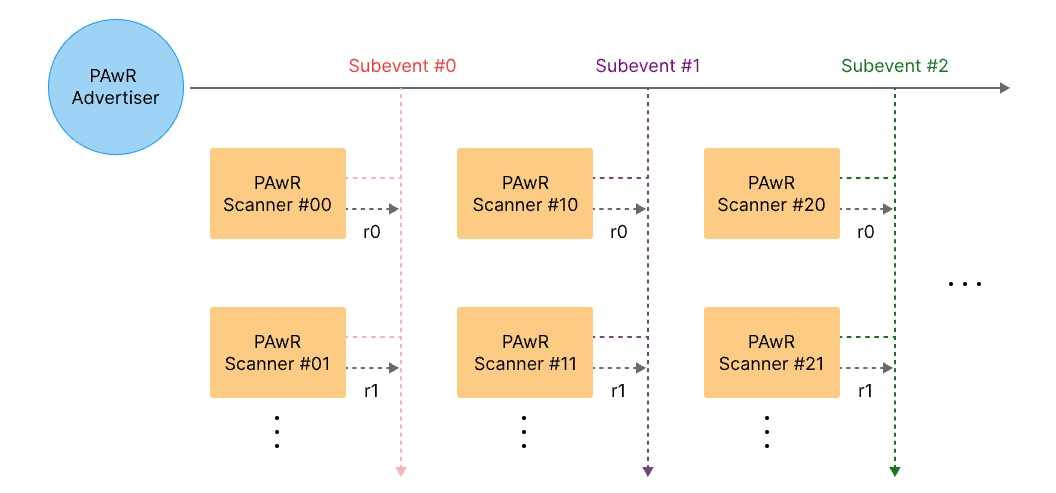
Within the PAwR mechanism:
- The data transmitted by the PAwR Advertiser can remain constant across periods or be updated every period.
- While synchronized, the PAwR Advertiser can initiate a Bluetooth® LE connection with an individual PAwR Scanner, without the need for connectable advertisements from the Scanner.
- If multiple PAwR Scanners transmit messages in the same response slot, a collision may occur, potentially preventing the PAwR Advertiser from correctly receiving any information.
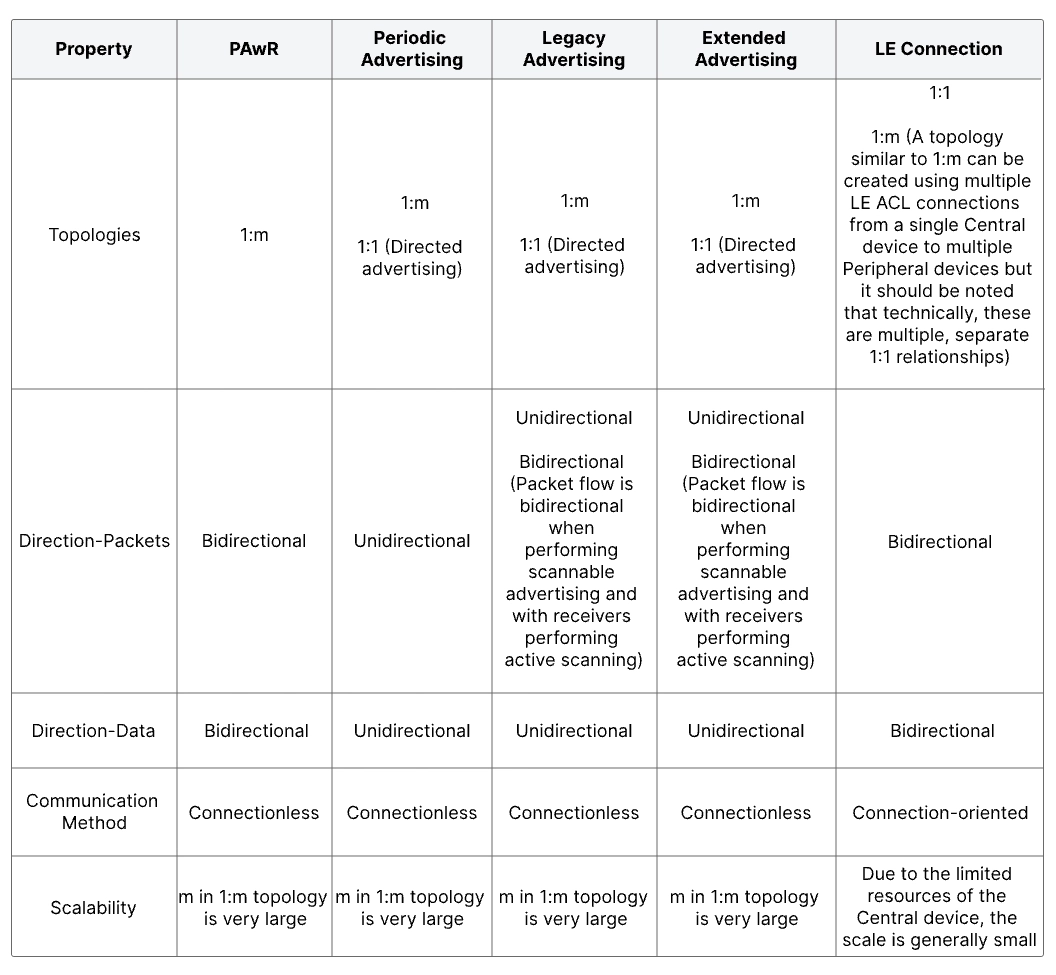
The following table compares PAwR with other Bluetooth® communication mechanisms:
Application Scenarios
- Smart Retail — Electronic Shelf Label: PAwR supports instantaneous and synchronized price and information updates across tens of thousands of electronic shelf labels.

- Smart Home / Building Automation: It enables efficient connectivity and management for a large number of security and environmental monitoring sensors, supporting reliable status reporting and centralized control.

- Wireless Battery Management System: PAwR's high-precision timing enables the simultaneous sampling of voltage and temperature data from all cells within a battery pack, meeting stringent functional safety requirements.





 苏公网安备32059002006558号