Applications > Smart Watch


Smart watches are fashionable accessories that integrate cutting-edge technology. They have an exquisite appearance and can be connected to mobile phones to receive notifications, play music, and make calls. They can accurately monitor sports and health data. Adaptable to various life scenarios, they are your intimate companions, making life more intelligent and convenient.
System Structure
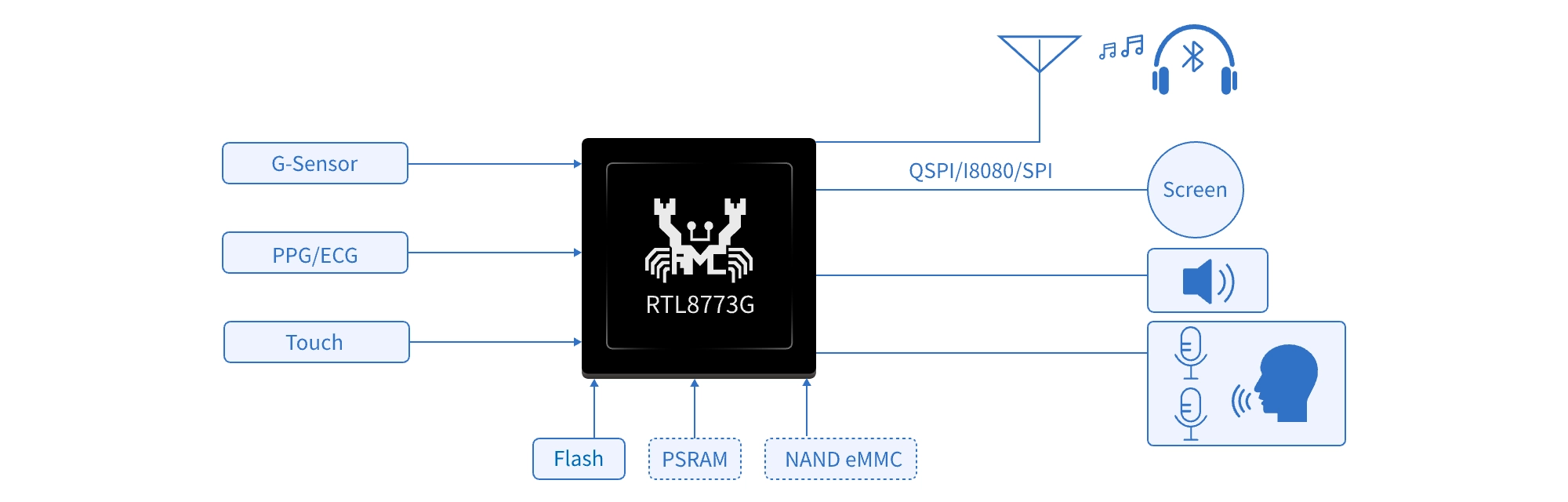
Realtek Smart Watch solution based on RTL8773E uses a single BT SoC as the main controller. It connects to peripherals via interfaces such as SPIC, I2C, SPI, GPIO, I8080, MIC, and DAC, and connects to phones via Bluetooth to create a highly integrated smart watch solution.
Realtek provides reference designs, SDK, and toolchains, characterized by high integration and ease of development.

RTL8773G-series smartwatch solution is based on a highly integrated single-chip BT SoC. Compared with the RTL8773E series, it offers a higher-performance MCU and DSP, a Helium vector engine, a 2.5D graphics engine, and JPEG encoding/decoding capabilities, delivering a powerful and feature-rich smartwatch platform.
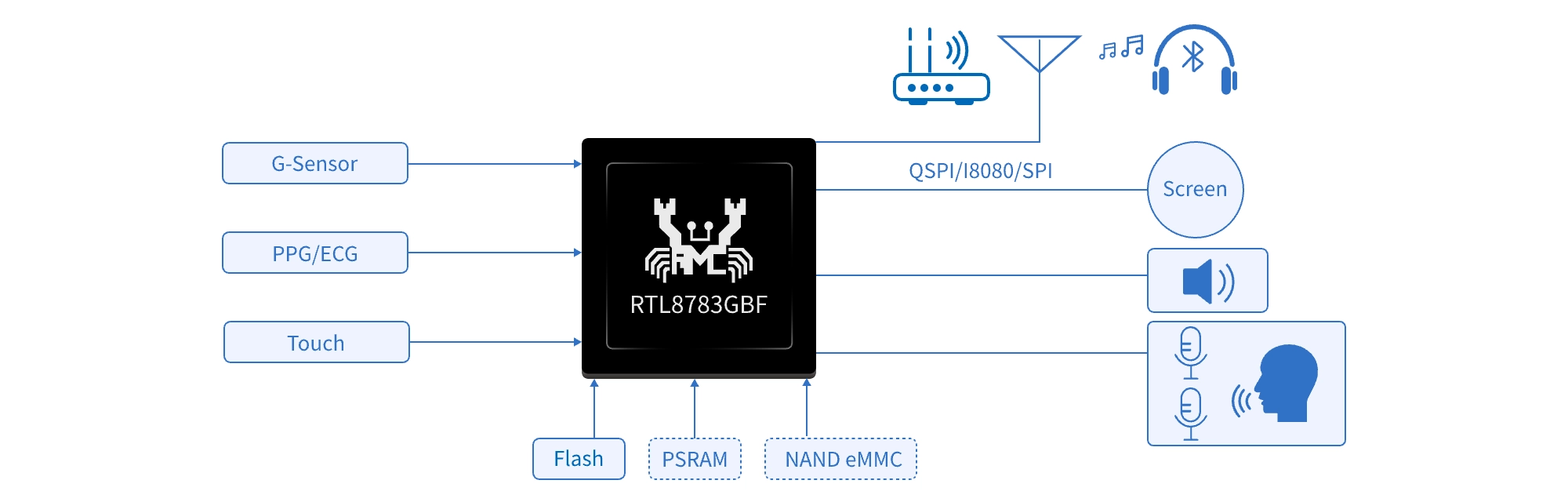
The RTL8783GBF smartwatch solution is built on the RTL8773G series, with further integration of Wi-Fi, on-chip 64Mbit Flash, and 128Mbit PSRAM, as well as more abundant I/O resources, making it ideal for high-end, feature-rich smartwatch designs.
Application Scenarios


Advantages of Solution

A 2.5D hardware graphics engine that supports rendering, scaling, rotating, deforming, and other processing of graphics.

CPU computing power and MCU memory provide sensor algorithms or external device control capabilities.

DSP computing power provides powerful speech and audio processing capabilities.

Supports interfaces such as GPIO/I2C/SPI/UART/ADC/DAC/MIC/I2S/SPIC/DC, and can be externally connected to a wide range of devices.

Includes Bluetooth LE, Bluetooth Legacy Audio, and LE Audio, Implement product requirements with the latest technology.

Provide HDK and a fully functional SDK development package that includes complete product prototype engineering, mobile APP SDK, OTA tools, and production tools, reducing customer development work and accelerating project implementation.
Start Implementing My Smart Watch Application
Define the product functionality, focusing on the graphical user interface (GUI), Bluetooth features, and audio requirements.
Chip selection: Based on functional requirements, select an appropriate chip solution and evaluate whether its performance, resources, and other parameters meet the needs.
Evaluation board procurement: Purchase the corresponding evaluation boards from online marketplaces to conduct functional evaluation and performance testing, ensuring the hardware platform meets the design requirements.
Apply for SDK resources: Register an account on Anchor and request the SDK documentation and resources.
Application development: Customize and implement the required functionality based on the SDK.
Validate that the developed functionality and stability meet the requirements, ensuring the quality of deliverables meets the required standards.
Certification preparation: Prepare relevant documentation and test reports, and apply for the necessary product certifications (e.g., Bluetooth certification, safety certification).
Mass production preparation: Complete production line setup and testing to ensure quality and consistency in large-scale production.
Recommended Chips
| RTL8773EWE | RTL8773EWE-VP | RTL8773EWE-VS | RTL8773GTP | RTL8783GBF | |
|---|---|---|---|---|---|
| MCU | RM300F, 100MHz | RM300F, 100MHz | RM300F, 100MHz | CM55 with Helium, 200MHz | CM55 with Helium, 200MHz |
| DSP | HiFi mini, 200MHz | HiFi mini, 200MHz | HiFi mini, 200MHz | HiFi Mini, 260MHz | HiFi Mini, 260MHz |
| Flash | Ext. | Ext. | Ext. | Ext. | 10MB |
| SRAM | 800KB | 800KB | 800KB | 928KB | 1.3MB |
| PSRAM | N | 4MB | 8MB | 8MB | 16MB |
| Bluetooth Version | Bluetooth 5.3 | Bluetooth 5.3 | Bluetooth 5.3 | Bluetooth 6.0 | Bluetooth 6.0 |
| Tx power | +13dBm | +13dBm | +13dBm | +13dBm | BT: +13dBm WIFI: +18dBm |
| RX sensitivity | -95.8dBm (1M BR) -95.6dBm (2M EDR) -100.6dBm (1M BLE) -96.5dBm (2M BLE) | -95.8dBm (1M BR) -95.6dBm (2M EDR) -100.6dBm (1M BLE) -96.5dBm (2M BLE) | -95.8dBm (1M BR) -95.6dBm (2M EDR) -100.6dBm (1M BLE) -96.5dBm (2M BLE) | -95.5dBm (1M BR) -95.5dBm (2M EDR) -100.5dBm (1M BLE) -96.5dBm (2M BLE) | -95.5dBm (1M BR) -95.5dBm (2M EDR) -100.5dBm (1M BLE) -96.5dBm (2M BLE) |
| Display Controller | QSPI/OPI: SDR 60MHz, DDR 40MHz | QSPI/OPI: SDR 60MHz, DDR 40MHz | QSPI/OPI: SDR 60MHz, DDR 40MHz | SPI SDR 70MHz QSPI/OPI: SDR/DDR 70MHz RAMless QPI SDR/DTR 70MHz I8080 SDR 40MHz | SPI SDR 70MHz QSPI/OPI: SDR/DDR 70MHz RAMless QPI SDR/DTR 70MHz I8080 SDR 40MHz |
| AMIC | 2 | 2 | 2 | 2 | 2 |
| DAC | 1 | 1 | 1 | 1 | 2 |
| GPIO (max) | 38 | 38 | 38 | 36 | 75 |
| I2C | 3 | 3 | 3 | 3 | 3 |
| UART | 3 | 3 | 3 | 6 | 6 |
| SPI | Master×3, 10MHz Slave×1, 10MHz | Master×3, 10MHz Slave×1, 10MHz | Master×3, 10MHz Slave×1, 10MHz | Master×1, 50MHz Master×1, 20MHz Master×1, 10MHz Slave×1, 10MHz | Master×1, 50MHz Master×2, 20MHz Slave×1, 10MHz |
| SPIC | 1, 80MHz | 1, 80MHz | 1, 80MHz | 1, 100MHz | 1, 100MHz |
| Package (mm) | QFN68, 7×7 | QFN68, 7×7 | QFN68, 7×7 | QFN68, 7×7 | BGA180, 6.8×8.8 |




 苏公网安备32059002006558号